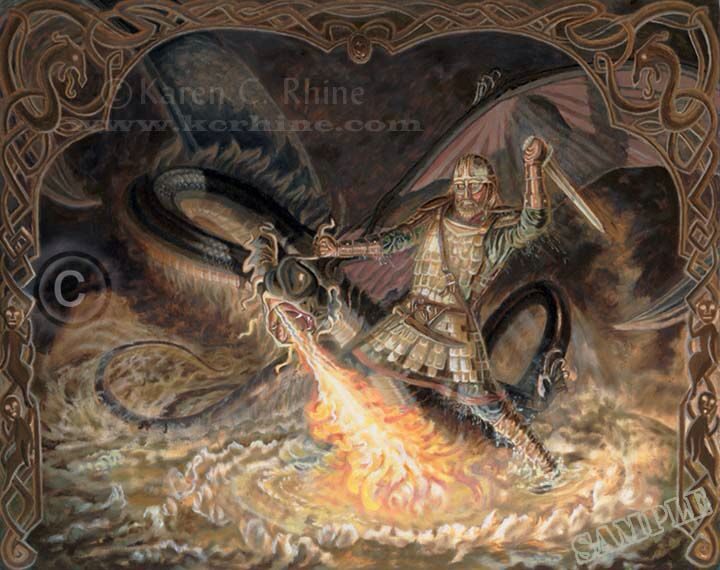
Beowulf; or, the Justifications of Toxicity

Featured

An Essay

____________________________

Is a book a classic only because of the period it has been written in? Countless works have been hailed as incredible classics when many find them dull, foolish, or poorly written. From the over-hyped Romeo and Juliet to the ridiculousness of Dostoevsky’s “The Idiot,” many fictions that are revered truly lack anything that makes them overly special. What would the general public say if they knew Romeo had been in love with someone else before Juliet? Or that the prince in The Idiot was truly a calculating politician? Beowulf does not deserve its praise, for it lacks any true emotion, plot, or well-defined characters, but instead dives far too deep into the male psyche, and their obsessive need for glory, fame, and fortune. Not only that, in fact, but also degrading female roles into either docility or villainy. 

Foremost, Beowulf lacks any true emotion or plot. Rather than display human vulnerability, or our tendency to err, the text only showed their bravado, confidence, and fear. No true happiness was felt, for no true sadness was borne. “Solitary, salt-scourged, he swam screaming over open ocean, Ecgtheow’s son repatriating grief-stricken to homeland.” (Line 2369, page 102). Rather than create an atmosphere of grief, or have Beowulf show any such in his actions, rather, they (The translator) said it once and then decided that must be enough to prove his sadness, for men show only strength. The sexism of this text showed once again, as they then spent a paragraph detailing how, in the wake of the battle that caused Beowulf to swim to safety that her [Hygd] husband died in, she did not even mourn him, as the author attempted to show women in the light of mercenaries, any negative emotion but rage a weakness to be exploited. The plot remained helpless to the emotionlessness of the texts, the book progressing in a series of exponentially convenient events. The first six pages (a costly amount in a 136-page poem) were merely background information, the majority of which was useless and had little to do with the main character, Beowulf, for whom this book was named. When Beowulf comes, he is honored oddly fast for a man coming to a foreign king bearing an army fit to destroy the king’s own. Rather than be fearful, they believe him unconditionally for their desperation and his silver tongue, following that by calling the king a “good king,” a recurring theme that was only precluded by shows of “manliness,” such as violence. No king was revered for their intelligence, but rather, for their ability to fight and win. The sexism was especially prevalent in, “He has no verve, no urge to visit beds, no wish to father a new son, now his firstborns dead.” (line 253, page 106). This displays the author’s contempt for men who show their grief, following a child’s death, displaying the activities they felt he should be doing before carelessly mentioning the cause of his reluctance. This is unempathetic, and frankly, quite disgusting that they believe a man is only allowed to be considered as such unless he does the aforementioned acts that can, in some and most circumstances, be considered sins to the Bible, for which this book mentions in droves. Following this was the unrealistic following of speeches. The characters would often have rather long-winded speeches, lasting for several pages, that they could have said “quickly?” One character, after Beowulf is killed, is passing by, on horseback, giving a speech about Beowulf’s death that lasts for six pages. Six. How is it possible that this speech could have been said, while on horseback nonetheless, for all to hear? Most would hear only a portion that would be out of context unless they decided to race after him to hear the end of his speech. That is highly unrealistic, even for a fantastical novel such as this, because though it may meddle in the affairs of magic, it is still grounded with earthly laws. 

Following this, it is paramount to mention that the characters of Beowulf lacked definition. They were merely caricatures, mockery of humanity unnamed. Beowulf, rather than being shown as a character with thoughts, feelings, and a past, was shown as a superhuman figure incapable of err, but rather prone to boast. The definition of a hero has been debated for hundreds of years, over whether it references deeds, or perhaps the character of them, but a common theme among heroes of the past is strength and bravery. The myth of Theseus and Ariadne is flagrant with such ideas, calling Theseus a hero despite his abandonment of Ariadne, and then marriage to her younger sister. His later actions were considerably horrific, from the kidnapping of a child for future marriage to the murder of his son. Could such actions be considered heroic? While it may seem I have wandered upon a tangent, the principle remains the same. Can a man be considered a hero considering his actions that lack heroism? Many of Beowulf’s actions could be considered positively villainous, even those that are meant to show his strength. The murder of the dragon, while written to appear justified, was hindered by the previous explanation that a man stole from her, and when she tried to warn all others away from her, they came to kill her for not allowing them access to the treasure she has spent centuries amassing. Are we meant to lynch billionaires who do not give as much to the public or charity as we’d like? This has value, even today. Beowulf’s character was a mere caricature of masculine heroism, while the only character that retained their emotional and historical value was the main villain of this tale, the dragon, who was then killed for attempting to defend herself and her home. The king also was mentioned merely to state that after his son’s death, he had no wish to do “manly” things, such as kill, or sire other children. The oddity of such a thing would not hold in the modern day, as a man who lost his firstborn would be justified in any refusal to have other children for grief or participate in bedsport as well. “Is there laughter in far-off places, at me, and at my men?” (line 474, page 23). This line displays his lack of regard for the lives lost to the first villain of this tale, Grendal, instead focusing on the shame it might cause him if others realized his plight. The characters of Beowulf, therefore, lacked any definition and were rather caricatures of toxicity and selfishness than true people. 

In addition, Beowulf was horribly sexist towards women. Sexism is defined by the Oxford Dictionary as, “Prejudice, stereotyping, or discrimination, typically against women, on the basis of sex.” Not only did they acknowledge within the definition that sexism is usually done towards women, but they also mentioned the stereotypes usually thought of as related. For example, “Heorogar, Hrothgar, Halga, and I heard he hand-clasped his daughter (her name’s a blur) to Onela.” (line 60, page 5). From the beginning, they establish a theme of female inferiority, even going so far as to say they did not know who married the great warrior Onela, for she was merely a woman to be his wife, not anyone of importance. Her name was a blur. “Hygd tried to quicken him with the throne, offering him gold, gemstones, a potent position, a life less lonely.” (line 2370, page 102). Hygd was a mercenary, her only goal being the protection of herself and her son. Not only that, but instead of having Hygd offer a mere prize if he returned to rule, she offered herself, degrading not only her position but her honor and mourning. Her mind was not mentioned, nor her cunning or intelligence, only her beauty and wealth, as they seemed to be the only things that made her valuable. Such an argument or point of view can be a picture-perfect definition of sexism and the demeaning of an entire gender within those few sentences. Continuing upon this line, Beowulf’s mother is never mentioned, yet his father is mentioned at least once every two pages, as they refer to Beowulf consistently as “Ecgtheow’s son.” This showed how the author believed women to be unimportant to the memories and development of children, and as adults, usually find themselves lacking their mother’s aid, so that the women who raised them might fade to obscurity. According to the Healthway Medical Group, “A mother plays multiple roles in a child’s development, as she is a teacher in every aspect of a child’s developmental growth – social emotional, physical, cognitive and independence.” If mothers remain so essential to a child’s development, why was her role demeaned in her absence throughout the book? Beowulf mentioned his father teaching him to be brave and to fight like a soldier, yet he mentioned not his mother, even though due to societal constraints at the time, we can assume not only he had one but was raised by her. Also, Grendal, who is often hailed as one of the main villains of the novel, was easily felled by Beowulf within a paragraph. However, Grendal’s mother necessitated an entire battle, armed to the teeth, saved only by luck and the will of God. Beowulf admitted she was a terrible foe to face, while with Grendel, he boasted about the ease of the kill. To describe Grendel’s mother- for she was nameless but for the son she sired- they said, “Now his mother was here, carried on a wave of wrath, crazed with sorrow.” (line 1274, page 56). They made it so that the only way a woman could possibly best or dare to fight a man is when they have gone insane from the death of a male family member. Can such a novel that supports these hapless and foolish attempts at sexism truly be considered a classic?

However, some might argue that Beowulf has examples of heroism, and bravery, and allows for analysis into male psychology. Indeed, they might quote, “ The horror wasn’t muted by the measure of women’s strength against man’s brawn. Both can hold slaying swords, glazed with gore, and score the boar crests from their war helmets, warming them with blood.”  (line 1284, page 57). However, this was precluded by descriptions of Grendal’s mother’s thirst for blood, followed by a disdainful explanation of women’s lack of honor on the battlefields. A single quote that is then argued upon by the same novel from whence it came is hardly an example of the beauty of this poem. Furthermore, they could possibly mention Beowulf contains themes necessary for understanding the time, perhaps portrayed in, “War was the wife Hrothgar wed first.” (line 63, page 6). This showed how they valued battle, for they had preceded this by mentioning how Hrothgar was a good king who destroyed his father’s legacy in order to build his own. In this, we could find a reason to argue as to whether or not war should be a thing that is worshiped so highly, however, we cannot argue that Beowulf does introduce the themes and semantics of the time, and so, that point cannot be argued. However, other books were written during that time (6th-10th century, approximately) such as Book of Fixed Stars (Year 964), Deor (Year 975), and many others that followed. If the only point that supports Beowulf is its representation of the time, many other books can and have as well. So why is Beowulf any better?

In conclusion, Beowulf does not deserve to be considered a classic of our time, with far too much sexism, no emotional depth within its characters, and a lacking plot as well. The heroes showed villainous traits, and the villains were far too human, and could only be thought of as the anti-heroes of the plot. Women’s role was heinously degraded, the entire gender forced into a single box that was meant to represent us all. Beowulf was a caricature, a man borne only to show heroism rather than be a true man at all. History is so much more layered than what they attempted to show, and that gray area exists as well. It is not merely black and white. While I cannot argue that Beowulf might have been a wonder for its time, now, in this era, Beowulf has truly lost its value. How can we progress if our minds, our entire idea of classics are still stuck not only in the past but in its outdated stigmas that we have come so far from? We are more than our past, and that is all Beowulf is. A poem that would do well to be forgotten in the shadows. 

Works Cited

Britannica. “Beowulf | Summary, Poem, Characters, Monster, Analysis, & Facts.” Britannica, 7 March 2024, https://www.britannica.com/topic/Beowulf. Accessed 18 April 2024.

Headley, Maria Dahvana. Beowulf: A New Translation. Farrar, Straus and Giroux, 2020.

Healthway Medical. “A Mother’s role in early childhood development.” Healthway Medical, 17 April 2020, https://healthwaymedical.com/a-mothers-role-in-early-childhood-development/. Accessed 18 April 2024.

Oxford. “The Oxford Online Dictionary.” Oxford English Dictionary, https://www.oed.com/?tl=true. Accessed 18 April 2024.

Featured

Lovely Worlds

Poetry by Sara Aziz

________________________

Planet of Beauty

^^^^^^^^^^^^^^^^^^^

Where a thousand things will float around the sky, fire, ice, and breathless lies,

Venus glides, a planet of beauty and shallow, indescribable follies.

Of dreams once sent,

of dreams never answered,

of beauty without substance, with only fire to its name,

and with its allure so callous and cold,

came the goddess of love,

Venus of old. Of astronomers who gazed upon the sky, when faced with the enchantress, could only cry,

And say it was fire, and say it was ice, and say it was full of terrible delights,

Of which their minds, so clever and irreprehensible, which were so fixed on what was unattainable,

Like the goddess of old, her beauty so fake, she shifted her form with every human she faced,

Ever changing, ever going, yet empty and cold, of malicious curlings in her veins, jealousy and hatred burning her brain,

She hated the glory that was not hers, and the myths say she was cruel as a world, of dry rivers and bare plains, of no air in the sky, no air we could breathe, and so we would die, in its elegance and pain.

A planet of fire,

A planet of ice,

A planet of beauty and terrible delights.

++++++++++++++++++++++++++++++

Planet of Seas

^^^^^^^^^^^^^^^^^

The planet of seas yet untamed,

of the blue face so many have named,

Of ice and fear and liquid life, of potential and quiet and human wonders,

of tears of worlds, yet unfound, have left their hopes upon its cold bounds,

Its serenity is unmatched, in a universe of silence, blackness, and fear, stretching for miles,

upon miles, upon universes of truths ours have yet to find.

And one we have,

we reject,

in the name of science, and yet for pride,

and yet insanity is called our lies, and have we no shame in our pronouncements and changes, of which should not be,

and yet the world goes on,

and yet the universe continues,

and for shame shall we go on,

and for shame shall we abandon the world our ancestors have built for this oasis of quiet,

in our world of torment,

a world of oceans,

and seas,

and peace,

yet untrod by our human feet.

+++++++++++++++++++++++++++++

Planet of Speed

^^^^^^^^^^^^^^^^

The burning planet,

set on fire,

from the flames that keep us alive, with a warmth that keeps us on our wits, and duels of honors broken vows,

it’s speedy in its revolving, the gods of Rome once sent,

and named him Mercury, and away he went, his sandals of gold keeping him aloft as he soared about to protect the lost,

and so the ancients could only say,

to this planet of speed and fire away,

‘Mercury, he is, and Mercury he shall be!’

And away he flew throughout the galaxy!

And so we hear, from time to time,

his laughter at our petty crimes,

and some say he still protects the lost and the lonely,

a smile and skip away,

and so the history is not gone, and the planets revolve,

spinning, spinning, until eternity and a day.

_________________________________________

Thank you for reading my poetry on space, “Lovely Worlds,” and please like and subscribe!

Featured

Beware! & Perchance,

Poetry on Human Emotion and Allegories by Sara Aziz

___________________________

Beware!

A mountain torn asunder,

A flash of lightning, filling the sky with white fire, the rain the tears of angels, as they weep for every lost soul that has cursed this wretched land!

Beware!

Beware the grass of poison, beware the hanging trees, their branches arms, their knots tearful eyes, as they weep for lost redemption!

Beware!

Beware these souls who wander the empty plains, searching for the final piece that eluded them in life, an obsession so great they cannot see they have withered and died, they have left their bodies behind, unknowing, yet searching, forevermore!

Beware!

Beware the wretched souls that haunt us, their immorality a black veil of grief as they shadow us all with their empty broken hearts of black and death, screaming of horrors like the demons of hell!

Demons, beware! Beware for every soul still guided by God’s hand, and when we die, may our actions stand behind us on our rights, a bright and shining light, so that may we stand tall again, in a life after this, so that may we stand tall again beyond the Gates of Heaven, and the Gardens of God!

___________________________

Perchance,

Perchance my soul will flame alit, with loving words and tender kiss, of mother’s love, and fathers pride, that give me hope, of a world beyond,

Perchance my soul will soar so high, the likes of which make angels cry, as I grow a heart, like a blooming rose, a pile behind me of actions grow, upon my right, not on my left, and so I beam with soul a-lift,

Perchance my heart will miss a beat, as I wait for love to look my way, perchance my heart will grow and brighten, leaving me warm like a roaring fire,

Perchance my mind will blank-or pause- before a rush of doubts and words will fall, perchance your mind might draw up plans, of the life you wish for, of the life you demand,

Yet perchance your soul will be snuffed and cold, a suffocation of sorts, a tale so old,

Perchance your heart might be torn in two, waiting for life to come to you,

Perchance your mind might well up with doubts, like a river of fear, a mountain of mistrust,

Perchance can mean a million things, a hope, a dream, a doubt, a sin.

Perchance life will find you,

Perchance it won’t,

Perchance you fall in love,

Perchance your heart will be torn in two,

A rhyme they sing in a meadow of frolic, and like the tick of a clock, your perchance will never stop, ’till you stand in that crowd, and take a deep breath, as the voice in your mind screams ‘Perchance, Perchance,’ till you smile and wave, and take the first step, till the voice in your head just fades away, and yes, you are vulnerable, and yes, you can be hurt, but you will never know, what will happen, ’till you walk up and say,

“Hello.”

+++++++++++++++

I hope you enjoyed my poetry, and please like and subscribe!

Featured

Humanity’s Poetry

By Sara Aziz

Hey readers, I hope you enjoy these poems! I’m a writer and a budding poet, so I’m still learning the ropes! This is my attempt to capture human emotion and feeling with poetry, so, hope you enjoy and please like and subscribe!

+++++++++++++++++++++++++++++

#1- Invincible We Are

Invincible we seem,

Stranger yet is the mind,

we value success,

and hide our faults,

invincible we are.

We’re taught to hide our grief and pain,

yet show our anger and our hate,

invincible we are.

We love each other,

yet all for one is what we say,

invincible we are.

We are not special we like to say,

we are unique we like to say,

we are human,

our final truth,

invincible we are.

And when we cry,

we brush our eyes,

embarrassed of an emotion,

invincible we are.

We scream,

we hate,

we laugh,

we challenge fate,

We’re strange beings,

I know it to be true.

We’re one for all,

we’re all for one,

Invincible we are.

#2- Immortality

Life once lived,

is a beginning to the end.

Life and Death,

twin souls.

We die,

we live,

yet fear hath no place among the dead,

for only those alive may feel terror,

for only those dead can feel the threads that connect all.

Dead,

alive,

broken,

whole.

Death and Life,

twin souls,

two sides,

to one coin.

One hate,

one hope.

Death,

is never to be feared,

for death,

is not the end,

but a whole new beginning.

#3- Sunlight

The sunlight hits upon your face,

an everlasting constant.

In a world of turmoil,

the sunlight hits upon your face,

in a world created for all.

#4- To Understand Nothing, To Understand Everything

What can I understand,

that you cannot?

Is it just a matter of circumstance,

a dancing, deadly,

yet adventurous game of chance?

What can I grasp that you cannot,

what makes us so different,

yet the same?

Broken,

and whole,

all at once?

+++++++++++++++++++++++

Thanks for reading my post on my Poetry and please like and subscribe!

Featured

3 Poems

By Sara

#1- Little Things

A single breeze,

Can brighten,

Someones,

Day,

A bit,

Of rain,

Incites,

Your joy,

As small bits,

Of nature,

Brighten someone’s day,

Another will lie,

In wait,

For a ,

Better,

day.

#2- Innocence

A robin,

Breaks its wings,

But stands alone,

A dove,

Shall fly,

Before it shall fall,

With a sigh,

Of defeat,

For the cry of the innocent,

Is the evil,

Of earth,

If called forth,

From the hate,

That is spread,

Through you.

#3- Evil

A slash,

Of violence,

Is all that you,

See,

When you,

Look at,

Me,

But,

What you see,

Is different,

Than you,

Believe,

For evil,

Shall,

Stand alone only,

When the motivation,

Is to,

Dark,

For you,

To ever,

See.

Conclusion

Thank you for reading my post on 3 Poems, and please like and subscribe.

Featured

4 Poems

By Sara

#1- Sea of Eternity

A splash,

Of water,

In a great,

Sea,

Is all,

That I,

Will ever,

Be,

But if I,

changed ,

Just one,

Life,

Just one,

day

Just once,

A happy,

Droplet,

I shall be,

As I fall into,

The sea,

Of eternity

#2- Alone

I wonder,

What the,

World would look,

Like,

If all,

Just stood,

in,

Unison,

The same, 

All,

Together,

Yet alone,

Surrounded by,

Millions.

#3- Flow On

Flow on,

Through the river,

Of life,

Of faith,

Of hope.

Flow on,

Despite,

Whatever holds,

You down,

In earthly chains,

Of stone,

And pain,

Flow on,

through the river,

Of life

Of hope,

Of change,

Flow on,

Despite your earthly chains,

Flow,

Flow on.

#4- Different

Whatever chains,

Hold you down,

Whatever makes you be,

So similar,

So different,

All in the same way,

You want to be,

Different,

You want to be,

Free,

But when all,

strive ,

For the same thing,

In the same,

Desperate,

Way,

You’re no different,

Than anyone,

Can hope,

To be.

Featured

10 Great Poetry Books and Resources for Writers and Readers

By Sara

#1- Poetry Foundation (Website)

Poetry Foundation allows you to read any poem for free, and you can always read book reviews as well! Have fun poets!

#2- Where the Sidewalk Ends by Shel Silverstein

The poetry book for kids was a great read, and I loved laughing at Mr. Silverstein’s humourous take on poetry. I would recommend this book to anyone, and reading Mr. Silverstein’s type of poetry inspired me to write poems, and hopefully, you as well!

#3- Bennington College Young Writers Awards (Competetition)

This competition is open to teen writers from 9th grade to 12th who want to write anything from fiction, to non-fiction, to poetry! The Deadline this year is November 1st, 2022, and the top prize is $1,000. If this competition sounds fun to you, sign up, and have fun!

#4- Quotidian Writer (Youtube Channel)

A great channel for writers, they give tips and tricks on a variety of writing topics, from adding emotion to your writing, to how to get over writers block! Great for writers who need a little help in certain topics of their writing, or beginner writers who want to know where to start.

#5- The Spiritual Poems of Rumi Translated by Nader Kalili

Great for readers and writers interested in making – or reading- more philosophical works! I enjoyed reading, and trying to imitate, Rumi’s work, and hopefully you will too!

#6- Inside Out and Back Again by Thanhha Lai

A novel told in verse, it’s a beautiful story of a girl’s life that was turned upside down by the Vietnam War. Forced to leave her home, now she must travel to America, a completely new land for her family, and she must learn to harness her own inner strength to survive here.

#7- SNHU 2022 Fall Fiction Contest

A fiction writing contest for writers who want to test their skill, there is no fee for this contest and the top prize is $3,000. The deadline is October 31st, 2022. So you better get writing, writers!

#8- Kanopy (Video Service)

Kanopy is a great resource for writers. Just search up videos on writing tips, and there will be lectures and videos that really help you understand your writing. I was recently listening to a lecture on Kanopy myself, and I think you will enjoy these lectures too!

#9- 365 Creative Writing Propmts by TMedia Publishing

A great collection of writing prompts, it’s perfect for travel and writing on the go! Writing with prompts helps you work on writing ideas you might not have explored before and you might find you like writing with a new style more! Have fun with these 365 Creative Writing Prompts!

#10- So, You Want to be a Writer? By Vicki Hambleton and Cathleen Greenwood

Great for kids who want to improve and maybe even publish their writing, it’s a fun and easy to understand how-to book with tips and tricks on how to,

  • How to fight writers block
  • Exercise’s to improve storytelling
  • How to find and agent and get published
  • How to promote your unique work

And more! I would recommend this to parents everywhere who want to help their kids writing.

Conclusion

Thanks for reading my post on 10 Great Books and Resources for Writers and Readers,

Please like and subscribe!